Friday, October 16, 2009

In search of old territory (October 16, 2009)

China’s global vision may not augur well for India

By Swapan Dasgupta

Barely three weeks after top officials, including the national security adviser, berated the media for Sinophobia and war hysteria, New Delhi has been stung by what it regards as an astonishing lack of reciprocity from Beijing. It is one thing for China to routinely issue proforma denunciations of the “splittist Dalai clique” and object to every journey undertaken by the exiled Tibetan leader. Yet, even by the exalted standards of Chinese insensitivity, the protest against the visit of the prime minister, Manmohan Singh, to Arunachal Pradesh for an election rally took the proverbial biscuit.

Those who make a living by deciphering the legendary inscrutability of India’s eastern neighbour may well suggest that the statement by China’s foreign ministry spokesman last Tuesday need not be taken literally. It can hardly be the case that Beijing seriously believed that the understated Manmohan travelled to Itanagar to “stir up trouble at the disputed area”. Yet, even a ‘nuanced’ view of the statement cannot distract from its symbolic significance. By targeting the Indian prime minister, China appears to have decided that only a frontal assault on Indian sovereignty over Arunachal Pradesh will serve as a deterrent to New Delhi’s going ahead with its ambitious infrastructural improvements in the state.

The sudden resurrection of the unresolved border problem over the past year — more or less since the Indo-US nuclear agreement passed all the cumbersome international and domestic tests — has upset some of the calculations of Indian strategists. Those who believed that Sino-Indian relations must be premised on economic convergence and healthy competition have been frazzled by some of Beijing’s wilfully provocative measures. Apart from the People’s Liberation Army’s ‘forward policy’ in Ladakh and Aksai Chin, China started issuing stapled visas for Indians resident in Arunachal Pradesh and Jammu and Kashmir. The clear message to New Delhi was that Beijing didn’t recognize these two states as integral parts of the Indian Union.

At the same time, there exists a great deal of muddleheadedness in India over how best to deal with China. The issue acquires considerable relevance in view of the recognition that in another 25 years or so China may well overtake the United States of America as the world’s largest economy in terms of gross domestic product. No doubt India, too, would have progressed considerably by then — PricewaterhouseCoopers estimates that India will be the fourth largest economy by 2025, after the US, China and Japan — but the distance between China and India would remain as yawning.

Of course, there is nothing inevitable about the rise of China at the cost of the West. Economic forecasts don’t factor in unforeseen developments such as political disasters and spectacular scientific advances that have the potential to upset calculations. The West, and particularly the US, may yet witness an unexpected surge and India has often demonstrated an uncanny knack of being its own worst enemy. Yet New Delhi’s long-term assessment of China must be based on the assumption that the balance of world power is likely to tilt eastwards, in favour of China.

For the moment, even as the world marvels at the Chinese miracle, Beijing has been careful to convey the impression that it will be a benign force that will follow the rules of multilateralism and not upset the existing rules of international relations. So far Chinese diplomacy has yielded spectacular results. The political eclipse of the neo-conservatives in the US has been accompanied by a discernible softening of attitudes to China by the Barack Obama administration. There is a greater inclination to celebrate the rise of China rather than resist it. The cancellation of the Dalai Lama’s meeting with President Obama may be as trivial as the decision to decorate the Empire State Building with China’s national colours to mark the 60th anniversary of the communist takeover but appear to be symbolic of a new accommodation.

Some questions arise from the retreat (I still hesitate to call it decline) of the West. Will China’s global role remain as benign after it has succeeded in overtaking the US’s GDP? The rules of international relations were determined by the West after 1945 and reflect the cultural bias of Europe and North America. Will China persist with the status quo once its economic hegemony is established? How will a new global architecture impact India?

The issue is important because China’s global vision incorporates a political hegemonism that is fraught with ominous consequences for India. With the Han Chinese constituting some 90 per cent of China’s population, Beijing’s view of race and ethnicity is, predictably, linked to China’s inviolable unity. However, as Martin Jacques has noted in his insightful book, When China Rules the World, “The notion of China and Chinese civilisation is bolstered by a widespread belief that the difference between the Chinese and other peoples is not simply cultural or historical but also biological.” There was a racial underpinning to 19th and early-20th century European imperialism and China’s rise may be accompanied by similar assumptions.

Such a mindset has a bearing on China’s quest for the recovery of its “lost territories”, not merely across the Taiwan Straits and Outer Mongolia but also along the McMahon Line.

Stemming from this sense of superiority is China’s inclination to perceive relations with its neighbours, in east Asia at least, in terms of the tributary system that prevailed before the entry of the Europeans after the Opium Wars. The system was based on an institutionalized inequality in relations between the Middle Kingdom and the tributaries, and a corresponding consensus over the superiority of Chinese civilization. With China dominating the economies of east Asian countries, scholars like Jacques are inclined to believe that “China’s economic strength, together with its enormous population, could return the region to a not dissimilar state of affairs to that which existed in the past”. There is a possibility that the scope of the new tributary system could extend into central Asia and Australia. This is not to say that China’s hegemonism will be uncontested.

India never fell into the orbit of a Greater China. Traditionally, the Himalayas were a barrier to the spread of Hindu civilization eastwards and Chinese civilization westwards. India and China have, consequently, evolved over the centuries with only nominal contact and little understanding of each other. Tibet was the only point of perfunctory contact. This mutual incomprehension and memories of the 1962 border war may be factors in the recent climate of distrust. But China’s attitudes towards neighbours also follow a template in which the tributary system is firmly etched. China cannot countenance India as part of the West but it has yet to evolve an alternative to viewing a neighbour as anything different from either a subordinate or a potential vassal.

The Telegraph, October 16, 2009

Tuesday, October 13, 2009

Rajiv Gandhi: Prince Gets Spoilt

He started sincere, but finally gave in to old party methods

By Swapan Dasgupta

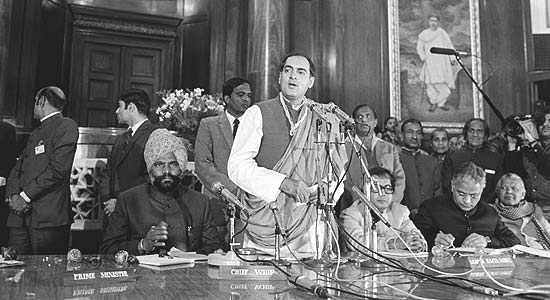
My initiation into the rarefied political salons of Delhi took place on the evening of December 31, 1984. I was on a fortnight’s visit to India to study the general election that had been called after Indira Gandhi’s assassination. As I was at a loose end that evening, an old college friend who was well connected to the city’s liberal fraternity suggested I accompany her to Romesh and Raj Thapar’s open house at Chanakyapuri.

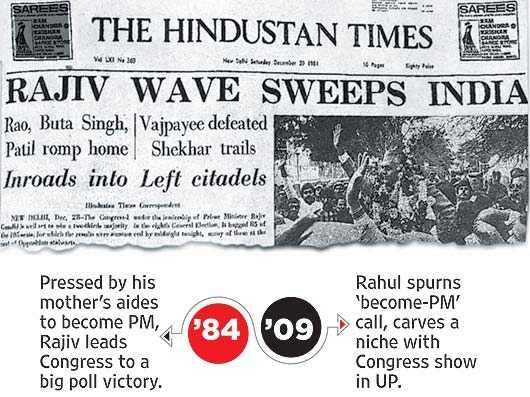
I was in a cocky mood that evening, having won numerous bets over the outcome of the election. In hindsight this may appear surprising, but a perusal of the English-language newspapers of December 1984 will show that the chattering classes expected the Rajiv Gandhi-led Congress to just about squeak through.


Having spent 10 days in Calcutta, I had a very different perspective. Even in strong Communist bastions, it seemed that the new prime minister had captured the popular imagination. There was a wave of revulsion in the middle classes when the imperious CPI(M) leader Somnath Chatterjee brushed away Mamata Banerjee—an unknown Congress candidate contesting the no-hope Jadavpur seat—as she tried to touch his feet after the filing of nominations. The Bengali mashima class (the proverbial  neighbourhood aunties) in particular were completely bowled over by the stoic dignity of Rajiv Gandhi as he observed the funeral pyre of his mother—an image repeatedly telecast by Doordarshan, the only TV channel available then. I saw Rajiv speak at an election rally in south Calcutta and observed the awe, curiosity and enthusiasm that greeted him—despite his halting Hindi and lines such as “Akali Dal ka prevarication”. Indira’s funeral pyre was a permanent backdrop, but there is no doubt that in 1984, Rajiv added a substantial incremental vote to the Congress kitty.

If the mood was so sympathetic to Rajiv and Congress in the refugee colonies of Calcutta and the rust belt of Howrah, my assumption was that it would be decisively more so in the states where the Congress was entrenched. When Karan Thapar (he was doing an election programme for a British channel) rang me three days before polling, I told him it     wasn’t going to be a mere landslide but an avalanche.

As the results started trickling in, I made a small detour to Connaught Place. Outside the red-bricked offices of the Statesman, a crowd stared at the election scoreboards and announcements. At each announcement of a Congress victory, there were cheers. But an exceptionally loud roar greeted the announcement that Amitabh Bachchan was comfortably ahead of H.N. Bahuguna in Allahabad; and an equally boisterous cheer followed the “flash” that Atal Behari Vajpayee had lost to Madhavrao Scindia in Gwalior.

The party that evening was more akin to a wake. The liberal intelligentsia was not amused by the outcome. There was considerable tut-tutting over the provocatively aggressive advertisement campaign run by the Congress, despair over the quite explicit anti-Sikh propaganda in the localities and occasional mirth over Rajiv’s relative inexperience. An elderly professor mocked Rajiv’s closest aides, the two Aruns: “One sold boot polish and one sold paint. Now they are going to run India!”

To someone born into a business ambience, the corporate backgrounds of Arun Nehru and Arun Singh didn’t seem a liability. Indeed, it signalled a refreshing change from the hypocritical dhotiwallas who dominated the legislatures and the brash kurta-pyjama acolytes of Sanjay Gandhi who were said to have organised the Sikh killings. India, I argued, needed reassurance after the trauma surrounding Mrs G’s assassination; with his awesome majority, Rajiv had the opportunity of bringing in some change.

That evening, as 1984 was rung out, I was in a hopeless minority. Delhi’s genteel liberals had decided that the masses had betrayed the classes and would pay a heavy price for letting emotions get the better of common sense. The liberal intelligentsia that had initially been the cheerleaders of Indira in her fight against the Syndicate in 1969, had been horrified by the Emergency and the rise of Sanjay Gandhi, had torn their hair in exasperation as the Janata experiment proved disastrous, had decided that Rajiv’s election meant giving legitimacy to dynastic succession.

In hindsight, their scepticism was prophetic. Yet, in 1984, only perfunctory attention was paid to this subversion of democratic principles. Actually, the subversion had begun in 1966, when Indira Gandhi took over from Lal Bahadur Shastri. But Indira’s accession was not regarded as dynastic politics for two reasons. First, her appointment was endorsed by Congress MPs after an election that also involved Morarji Desai. Secondly, Indira was perceived by the “progressive” wing of the Congress as a foil to the party bosses. She had a claim independent of her status as Nehru’s daughter.

It was the Emergency and the rise of Sanjay Gandhi that signalled the end of innocence. By the time Indira returned triumphantly to power in 1980, it was clear the Congress had been restructured on the basis of loyalty to the leader and her family. When a reluctant Rajiv was made general secretary of the party in 1983, ostensibly to “help Mummy”, the writing was clearly on the wall. When he was sworn in post-haste as prime minister by an ever-obliging President Zail Singh on October 31, 1984, India was mentally conditioned to dynastic succession, at least in the Congress.

Yet, Rajiv’s appointment and election victory was more than just a “The Queen is dead, Long live the King” proclamation. The son was very different from his mother who, in the months before Operation Bluestar, seemed headed for a possible election defeat. In 1984, Rajiv represented a freshness of style, a partiality to technology (as symbolised by his penchant for computers) and a willingness to break away from his mother’s cussed partisanship.

The term Generation X hadn’t been invented but Rajiv did symbolise the arrival of the “Beatles generation” (Arun Singh’s memorable phrase) at the doors of governance. “We are in power now,” a Cambridge-educated professor at iim told me shortly after the election. He was reflecting the optimism and hope of the well-heeled generation that had chosen to stay back in India through the gloomy years of the shortage economy. The belief that Rajiv would inject decency into politics contributed immeasurably to making dynastic succession acceptable to non-feudal India. He was, after all, the only prime minister since Independence who had earned a living outside politics.

Yet, there was a catch: what one section perceived as decency was seen by the entrenched political class as the arrogance of the English-speaking elite. For a long time, Rajiv never came to terms with the existing rules of the political game; like many before him, he felt he could connect with “real India”, minus the disreputable intermediaries. His “power brokers” speech at the Congress centenary in Bombay in 1985 reflected that restlessness.

Tragically, the unease was short-lived. The headiness of 1984 was in three years replaced by the shoddiness of the Shah Bano U-turn, the Bofors scandal, the departure of the two Aruns and the revolt of the Raja of Manda. By then, Rajiv had been well and truly coopted by the system. The flicker of hope some of us felt that winter evening of 1984 had been extinguished.


Outlook, 14th anniversary special issue, October 11, 2009

We're connected, but not enough (October 11, 2009)

By Swapan Dasgupta

In his semi-autobiographical novel Summertime, shortlisted for this year’s Booker Prize, the South African-born writer J M Coetzee painted a vivid picture of the white Afrikaner mentality in the heydays of Apartheid in the 1970s. Personally appalled by the iniquities of Apartheid, Coetzee initially believed that far-flung rural communities, insular small towns and a language that wasn’t spoken anywhere outside South Africa made for the Afrikaner ‘‘misreading of history’’ and their inability to detect the winds of change across Africa.

On reflection, however, Coetzee felt this explanation was ‘‘misleading’’. The Afrikaners, he wrote, had ‘‘read no history at all. On the contrary, they turned their back on it, dismissing it as a mass of slander put together by foreigners who held Afrikaners in contempt... Alone and friendless at the remote tip of a hostile continent, they erected their fortress state and retreated behind its walls: there they would keep the flame of Western Christian civilization burning until finally the world came to its senses.’’

It is probably unfair to single out the much-derided Afrikaners for retreating from the big, bad world into a Never-Never Land built on righteous certitudes. The desire to preserve, at all cost, a cherished way of life against the encroachments of modernity and godlessness, is a feature of many communities. This may partly be explained by pride in indigenous value systems and a sense of contentment with a familiar world. But, as is apparent from the Afrikaner experience, the dividing line between self-pride and intolerance can be very thin. The Afrikaners had every reason to be proud of the achievements of the early settlers, their ability to transform the bush into rich farmland and the community’s collective doggedness during the Boer War. However, community pride also came with the conviction that blacks lacked enterprise and were incapable of self-government. In the Afrikaner perception, blacks were an inferior race.

It is reassuring that the world has moved on from the days Hitler trumpeted the ‘‘master race’’ and Apartheid ideologues cited theology to justify crude racism. With more international travel and better communications, the earth has become smaller. Peoples and communities still take pride in their own worlds but at least their perception of others isn’t always bound in ignorance and stereotypes. But there are significant exceptions. Religious dogmatists, cultural xenophobes and racists keep popping up in the unlikeliest of places, from Afghanistan’s wastelands to the cyber world.

Despite an epidemic of political correctness, prejudice is flourishing. To expect otherwise is unrealistic. As long as humans have strong likes and dislikes based on culture, beliefs and tastes, there will be prejudice. Yet, there is a crucial difference between prejudice and intolerance: one is benign, the other malevolent.

When it acquired mass popularity some 15 years ago, the internet was seen as a means of bringing the world closer. The web bridged distances, nations, hierarchies, information walls and tariff boundaries. Its consequences were revolutionary, as profound as the invention of the printing press. By giving every individual with an internet connection the notional right to engage with every corner of the globe, the web also became an invaluable instrument of democracy. With blogging, every individual now has the means to skip intermediaries and disseminate his thoughts globally.

With such an onrush of hitherto untapped creativity and access to so much information, the world should have experienced a colossal intellectual explosion. Unfortunately, compared to the potential, the gains have been relatively modest. The world may be better connected and better informed. But have these led to a better understanding?

The answer is a categorical No. Far from dismantling barriers, the ultra-democratic web world appears to have been hijacked by activists cast in the mould of Coetzee’s bigoted Afrikaner. Far from promoting interaction between writer and reader, public affairs websites have been overwhelmed by hateful abuse and bigotry. Race and religion, the two pillars of yesterday’s intolerance, have been unashamedly resurrected and supplemented by slander. Sober debate and civilised bantering have been replaced by extremist sloganeering and organised bullying. It is particularly intriguing that many of the offenders are people who have one persona for the real world and an ugly personality that manifests itself the moment they sit before a computer. No wonder sensible (and sensitive) people recoiled in horror: they have either become passive net users or migrated to Facebook and Twitter where you can choose friends and followers.

The more things change, the more it remains the same. The Afrikanerdom Coetzee experienced in the 1970s has changed, and for the better. But a new trash has inherited the ghettoised paranoia and self-righteousness of the past and stepped in to subvert one of mankind’s greatest achievements. The worst offenders are in the US but Indian abusers are not far behind.

Sunday Times of India, October 11, 2009

Undeterred India must help Kabul (October 11, 2009)

By Swapan Dasgupta

It is fortuitous that the increased security arrangements after the blast of July 2008 prevented any Indian casualty from last Thursday’s repeat attack on the Indian Embassy in Kabul. Yet, by killing 17 innocent Afghans, mainly visa-seekers, the perpetrators managed to send a chilling message to the Government in Kabul and the US-led NATO forces that India’s nominal presence in Afghanistan will be violently contested.
It is reassuring, at least judging by the forthright reaction of Foreign Secretary Nirupama Rao, that India will not countenance any intimidation from either the Taliban or Pakistan. It can only be hoped that the gaffe-prone ministers in the Ministry of External Affairs don’t mess with this resolve by suggesting that India can do business with the Taliban (as SM Krishna did to Wall Street Journal last month) either directly or through Twitter.


That the Afghan Taliban and the Pakistan military establishment are flip sides of the same coin is a widely known fact many in the Barack Obama administration choose to wilfully overlook. Yet, ignoring reality or inexplicably winning a Nobel Peace Prize for good intentions does not change the ground situation. It does, however, embolden Pakistan into making life even more miserable for the “foreign” troops that deprived the country of its free run in Afghanistan prior to 2002.


Pakistan’s involvement in the July 2008 bombing was confirmed by both the authorities in Kabul and US intelligence. But even damaging charges of organising cross-border terrorism has left Pakistan unfazed. The cockiness won’t change if yet another smoking gun is held up as proof of its role as the sponsor of last Thursday’s outrage.


Pakistan’s arrogant belief that it can play by its own rules didn’t come about in isolation. In the present context, it owes almost everything to the widespread global belief that the Obama Administration is in complete disarray over how to cope with Afghanistan. From Obama’s perspective, Afghanistan is a mess he inherited from his predecessor. That’s only partially true. Whereas President George W Bush was clear in his mind why the US forces were there in Afghanistan and who they were fighting against, Obama’s conception is hazy and angst-ridden. In a series of high-level consultations involving both his military and civilian staff, the US President is reported to have repeatedly asked: “Who is our adversary?”
Such a profundity can impress well-meaning Norwegians into handing out a Nobel Prize. But it is nevertheless revealing. It suggests that, like those who drove his election campaign to heights of frenzy, Obama just wants to get the hell out of Afghanistan, even if that leads to the devastated country turning into what General McChrystal termed “Chaos-istan.”

American liberals have always been uneasy with the “war on terror.” After eight years of zero terrorism inside the US, they now feel the danger is past. This is the sub-text of the proposal doing the rounds of Washington DC that the fight ought to be against Al Qaeda and not the Taliban as if they live in separate worlds. Pakistan is pandering to that defeatism by appearing to come down hard on some of its own Islamist deviants.


The Obama Administration — described recently by one of its critics as the “biggest bunch of crybabies” seen for a long time inside the Beltway — mirrors the mood of its liberal constituency. It is desperately looking for a way out of Afghanistan and ignoring the views of its military brass, particularly General McChrystal’s demand for 40,000 more troops. Left to himself, Obama would willingly outsource Afghanistan to Pakistan and Saudi Arabia and focus on what interests him — twisting India’s tail on climate change and non-proliferation and fighting Fox News and Rush Limbaugh on healthcare.


Pakistan has shrewdly assessed Obama’s vulnerability. It is aware that Obama needs Pakistan more than it needs the annual US package of $1.5 billion for the next five years. Pakistan may be the catchment area for mercenaries but it is not willing to sell itself cheap. The custodians of Pakistani national interest know that a total of $7.5 billion tied to the Kerry-Lugar Bill’s conditionalities is nothing compared to what Pakistan will gain by recovering Afghanistan.


Pakistan is aiming for the Afghanistan that existed prior to 9/11, a country that was under its sole influence. It may take firm steps to keep some of Osama bin Laden’s hotheads from mounting attacks on the Saudi princes and targets in the West but as far as it is concerned, all attacks on Indian interests is kosher. The Pakistan military establishment wants to scuttle anything in the Kerry-Lugar Bill which restricts its operational independence. It doesn’t give a fig whether or not the US Congress issues it a good character certificate or not. It is proceeding on the simple assumption that the US and NATO forces want to leave fast and have no one but Pakistan to hand over charge before flying away on the proverbial last helicopter out of Kabul.


For Pakistan, events in Afghanistan seem a win-win situation. Its worst nightmare is if General McChrystal now gets it into his head that no decisive victory against the Taliban is possible unless there is a simultaneous assault on the lifeline of the movement in Quetta and other parts of Pakistan. There is an additional concern. What if the US-led forces suddenly feel that Afghanistan’s future is better protected by those non-Pushtuns who kept up the fight against the Taliban in the mid-1990s, when the world forgot Afghanistan?


Of course, the US won’t do anything so far-sighted. But that shouldn’t deter India from deciding unilaterally that its old friends in the Northern Alliance need some extra encouragement. India has been bizarrely charged by General McChrystal with “exacerbating regional tensions” by helping the Afghan people. It’s time we made it a self-fulfilling prophecy.

Sunday Pioneer, October 11, 2009

Monday, October 05, 2009

Impressive but joyless celebration (October 4, 2009)

By Swapan Dasgupta

The most interesting feature of the 60th anniversary jamboree in Beijing last Friday was its reportage. In a seven-column, front-page report, the editor of The Hindu (who was favoured with “ringside seats” of the choreographed event) was bowled over by the proceedings. With breathlessness that seemed a prosaic re-run of Leni Riefenstahl’s breathtaking documentary on the Berlin Olympics of 1936, he proclaimed: “China celebrated the 60th birthday of the People’s Republic in magnificent style, parading its new high-tech military prowess and showcasing its post-1978 economic development and its rapid rise on the world stage in a 150-minute Tian’anmen event that did not neglect to refer back to 20th century revolutionary history. In the process, it sent out a clear message that while the country is strong and determined enough to use all its resources to protect its interests — beginning with the “one China” imperative — what it wants above all is an internal and external environment conducive to development and the improvement of the lives of 1.3 billion people.” Phew!


The Hindu editor attached a great deal of significance to President Hu Jintao’s speech on the occasion which “left no doubt about the path along which China was headed”. Among other things, Hu proclaimed: “We must unswervingly follow the road of socialism with Chinese characteristics…and the reform and opening-up policy…The development and progress of New China over the past 60 years fully proved that only socialism can save China and only reform and opening up can ensure the development of China, socialism, and Marxism.”


The Hindu’s endorsement of China’s vision recalled a line penned by American journalist Lincoln Steffens after a visit to the Soviet Union in 1920: “I have been over into the future and it works.” In 1949, Mao took over a devastated, poor country. This year, China overtook the US as the biggest market for luxury goods. If only Mont Blanc had produced a limited edition Mao fountain pen!


The Hindu’s gush-gush was in sharp contrast to a New York Times report of September 30 which quoted Zhang Ming, professor of politics at Renmin University in Beijing, as saying: “There is no ideology in China anymore. The Government has no ideology. The people have no ideology. The reason the Government is in power is because they can say: ‘I can make your lives better every day. I can give you stability. And I have the power.’ As long as they make people’s lives better, it’s OK.” As an afterthought, the professor asked: “What happens on the day when they no longer can?”


That’s a question which has preoccupied the rulers in Beijing. Describing the arrangements for the Tian’anmen parade, Peter Foster of London’s Daily Telegraph observed things Indians, quite inexplicably, don’t. “At a time when China has more than most countries to celebrate”, he wrote, “the Party still does not dare to invite the people on to the streets to celebrate its 60th year in power. Some 200,000 carefully vetted students and volunteers will take part in the made-for-TV parade, but ‘security considerations’ will keep the common man at a safe distance. Not unlike the opening night of the Olympics, where the streets of Beijing were devoid of celebrations, it will be an impressive, but strangely joyless affair.”


In The Wall Street Journal, Gordon G Chang, author of the ominously titled The Coming Collapse of China, suggested that the Chinese Government is “deeply insecure”: “The theme of the celebration is ‘The Motherland and I, Marching Together.’ But so great is the regime’s worry about possible unrest or disruption in protest of its rule that the laobaixing — ordinary Chinese — will not be walking in Beijing’s parade. There will be no cheering crowds lining the route along Chang’an Avenue. Citizens will be kept away by a six-province security perimeter and more than a million police and ‘volunteers’ enforcing the tightest security in the country’s history. The Government has booked all the hotel rooms overlooking the route to prevent anyone from seeing the parade up close. Nearby residents have been ordered not to look out their windows or invite guests.”


Those who witnessed the Chinese panic over the passage of the Olympics torch through New Delhi will know that Chang isn’t exaggerating.
What should we in India make of these sharply divergent perceptions of the Middle Kingdom? The one which comes through from “ringside” seats reserved for the ideologically blessed is an awesome military power, goose-stepping its way into the future and proclaiming socialism. The other perception is of an entrepreneurial people in a mad rush to prosperity, slightly cynical about the Party and those in power. Both perceptions are real because China, like India, is home to a million truths.


Both images also serve a purpose. The spectacle of 50 new weapons systems unveiled for the first time by a determined People’s Liberation Army is calculated to put the fear of god into non-militarised societies. It is aimed at intimidating both the non-Han minorities within and nations who imagine that they can compete with China economically, host the “splittist Dalai clique” and, worse, question China’s imperial boundaries.


The other view of a “normal” society where people can abuse the rulers is meant to reassure democratic societies that China isn’t a latter-day version of the regime that built autobahns, won medals at the Olympics and manufactured the Mercedes Benz and the Volkswagen. Actually, placating the soft West proved remarkably easy. The Empire State Building was lit up in China’s national colours and Bejing’s Ambassador in London was given space by the bleeding-heart Guardian to prove China’s “democratic” virtues.


Money, it would seem, works wonders in the capitalist heartland. As for those States that share an undefined border with China, guns can do the talking.

Sunday Pioneer, October 4, 2009

Thursday, October 01, 2009

Seen from a distance (October 2, 2009)

The change in Bengal is likely to be momentous and damaging

By Swapan Dasgupta

From a media perspective, there are three markedly different ways of assessing the politics of an Indian state. There is, first, the worm’s eye view of events; there is the view from the discreet vantage point of the regional capital; and there is, finally, what may be called the Google-Earth detachment. Readers of these pages will be familiar with the first two approaches in viewing West Bengal. What follows is an exploration of how the present churning in West Bengal is being seen from a distance. The perception may suffer from the over-generalizations of a foreign correspondent’s report. However, since all decisions relating to the state aren’t made by those familiar with local nuances, it may be instructive for West Bengal to gauge its image in the wider country.


A convenient starting point may be the Lok Sabha elections held earlier this year. In the aftermath of its disastrous performance, the central committee of the Communist Party of India (Marxist) issued a sombre statement on June 22. The party, it admitted, “has suffered serious reverses”, having won only nine seats (its allies won a further six) in West Bengal. While noting that the 5.33 per cent popular vote it secured throughout India was only 0.33 per cent below what it polled in 2004 (but had yielded only 16 seats compared to 43 in 2004), it expressed “concern about the erosion in the Party’s support base in West Bengal and Kerala”. At the same time, it put on a brave face, pointing out that the Left Front in West Bengal secured around 1.85 crore votes and in Kerala the Left Democratic Front had polled 67.17 lakh votes. Its conclusion was characteristically blasé: “Though there is some erosion, the main base of the Party is intact by and large in these two states.”


Setting aside the details of the anticipated debacle in Kerala, where election results invariably follow a see-saw pattern, the central committee can be accused of being wilfully disingenuous in its assessment of West Bengal. True, the popular vote for the Left Front slumped only nominally, from 1.88 crore to 1.85 crore. However, in the context of the turnout and an enhanced electorate, its support fell by a staggering 7.42 per cent — from 50.72 per cent in 2004 to 43.30 per cent in 2009. The CPI(M)’s own vote share fell from 38.57 per cent to 33.10 per cent. More important, the Left Front lost nearly every seat in what is loosely called the FM belt around Calcutta. There is ample evidence to suggest that a substantial body of Muslim voters switched over to the Congress-Trinamul Congress alliance and contributed to the Left Front defeat. The ruling coalition just about managed to save face by winning a clutch of seats in the Jalpaiguri-Cooch Behar belt of North Bengal and successfully defending its strongholds in the outlying districts.


The electoral transformation of a state that has been a Red stronghold for the past 32 years — the LeftFront won a majority of seats in every Lok Sabha and Assembly election since 1977 — is calculated to have traumatic consequences. Left rule in West Bengal was qualitatively different from other states in India. It was based on the principle of ascending control: loosest at the very top of the social pyramid and rigidly suffocating at the base. Other ‘bourgeois’ political parties that run state governments operate primarily as electoral machines and build fledgling networks of patronage. They leave day-to-day governance and development projects to the bureaucracy. The CPI(M) politicized almost every aspect of administration in West Bengal. It empowered its local committees, particularly in semi-urban and rural localities, to work as a parallel administration, overseeing all government work including policing. The process began in 1978 during Operation Barga but gradually engulfed every institution, including the arbitration of local disputes. Education was a particular casualty of political control: the CPI(M) insisted on controlling every appointment, from the peon to the vice- chancellor.


The CPI(M) control of local administration proved politically rewarding. The party also became a permanent election machine, blessed with the ability to deliver votes through means both fair and foul. Dependant on spontaneity (the proverbial ‘wave’) and the charisma of individual leaders, its opponents were in no position to match this streamlined machinery of harnessing votes.


A structure based on over-intrusiveness could endure as long as electoral success was guaranteed. The undivided Congress always had a vote share of nearly 40 per cent — impressive, but never enough to take on a united Left. After 1997, a divided Opposition made the task of the Left very much easier but also added to its complacency and arrogance. The excesses of Nandigram and the perceived over-zealousness of the chief minister in Singur revealed chinks in the CPI(M) rural base. Muslims ended up being particularly agitated and the ultra-Left, a euphemism for Maoist fractions, entered into a tactical alliance with Mamata Banerjee to settle scores with the main enemy. The TMC-Congress alliance ensured a level playing field in electoral arithmetic. The chemistry of an all-India election did the rest.


The immediate effect of the Left Front defeat is that the structures of control are fast unravelling. Many of those who sided with the CPI(M) because it was locally convenient have switched sides and others, including a section of the police, are negotiating their safe passage. The Maoists have taken advantage of Mamata’s political umbrella and the indulgence of the left-leaning intelligentsia to both settle scores with the CPI(M) and build bases in outlying areas. A section of Muslims with a sectarian agenda is eyeing a post-CPI(M) dispensation as being favourable to a brand of politics that West Bengal hasn’t witnessed for a very long time. For the moment, the minority community is either with the Congress or the TMC. But will its sectarian fringe don true colours after the assembly election of 2011?

The Left is in a state of paralysis for two reasons. First, the more ideological of the comrades have realized that large contingents of the party’s foot-soldiers were mercenaries and fair-weather friends. They are relieved at their departure but also recognize the damaging impact of these desertions on the party’s election machinery. Secondly, the Lok Sabha election was a personal defeat for the development politics of the chief minister, Buddhadeb Bhattacharjee. The verdict has made it abundantly clear that State-facilitated industrialization will be thwarted by the general opposition to land acquisition. The beneficiaries of Operation Barga, it would seem, are loath to abandon their attachment to land in just one generation.


To the outside world, these developments are alarming. Since 1967, West Bengal has acquired a reputation for being obstreperous, mindlessly militant, over-politicized and even violent. The impressions may have been based on stereotypes, but they were real and contributed immeasurably to the state being left out of India’s growth story. For a brief period, it seemed that the chief minister was reinventing West Bengal. Now that seems like an illusion. With Mamata trying to outdo the CPI(M) in being cussed and difficult, there is a feeling that the run-up to the assembly election will witness a rash of agitational politics and spiralling violence. To cap it all, as the CPI(M) loosens its control, there is the additional threat of Maoist violence and the growth of Muslim communal politics.


West Bengal may be on the cusp of momentous political change and the end of Left dominance. But the process of change is likely to be very damaging. At least that is what it seems from the outside.

The Telegraph, October 2, 2009


Sunday, September 27, 2009

Absolving Maoists of their crimes (September 27, 2009)

Swapan Dasgupta
In the late-1960s and early-1970s, it was not unusual to hear about young men and women from privileged backgrounds breaking off ties with their families, catching a train to some god-forsaken place in Bihar and then going “underground”. When I joined Delhi’s St Stephen’s College, unquestionably a citadel of both excellence and privilege, in 1972, there were many who viewed all imports from Calcutta as potentially suspect and contaminated with the Naxalite virus. After all, too many bright sparks had abruptly disappeared into the countryside in search of the class war that would finally liberate India and elevate China’s Chairman into “our Chairman”.


Mercifully, such puerile manifestations of impatience with the old order yielded little fruit. The majority of those who packed a pair of jeans and tried to persuade poor peasants that they should hack the local landlord into pieces and feed the jackals, returned dejected and traumatised. Most of them had done nothing really purposeful during their “underground” stint but there were a few who had taken the perverted prophet Charu Mazumdar at face value. Some had indeed killed hapless traffic policemen, ageing vice-chancellors and third-rung politicians.


These amateur criminals posed a problem both for their parents and those in charge of stamping out the Naxalite movement. Fortunately there is one law for the aam aadmi and one law for those who have connections. Thanks to an astonishing show of flexibility by the authorities, the PLU murderers were given a way out. Their parents were advised to send the deviants to a foreign country and make sure they didn’t return in a hurry. Most never did. The US in particular hosts a large number of law-abiding people of Indian origin who were banished from the mother country for heinous crimes. In the old days, criminals in England were transported to Australia and French criminals suffered on Devil’s Island. Four decades ago, we sent off our political criminals to taste life in the heartlands of capitalism. It was the most agreeable punishment devised by an otherwise brutal state.


Needless to say, this punishment was reserved for some. The Indian state came down hard on the less fortunate. Few of them have lived to reflect on their misguided past.


The ones who went “underground” for a lark returned to their normal lives after hunger and dysentery overwhelmed their Maoism. The few who were truly agonised over the plight of the poor joined the Human Rights and Civil Liberties groups. It was a prudent change of tack since these bodies have been generously funded by angst-ridden Europeans (if only to show that India is at the core a rotten Third World country) and have evolved into overground service centres for every conceivable group that is waging war on the Indian state. In hindsight, Charu Mazumdar’s investment in the brat pack of the 1960s has paid off. Today, in the guise of protecting civil liberties, they operate as ideological covers for any group that wants the disintegration of India.


It is necessary to provide a background to the contrived tear-jerking that is being witnessed in the English-language media over the arrest of one Kobad Ghandhy, an ideologue and Politburo member of the outlawed CPI(Maoist). Normally, the arrest of a senior Maoist leader doesn’t lead to every cub reporter shedding tears. But Ghandhy’s advantage is that he came from a rich Bombay family, went to Doon School, bummed around London in the 1970s, was a leading light of the Human Rights industry and, finally, went “underground” to service a group of armed murderers.

Of course, Ghandhy has probably never killed someone personally or planted one of those deadly mines that have led to the deaths of policemen and para-military forces in Chhattisgarh. For that matter, he was probably never personally around when his comrades turfed poor Adivasis out of their homes for the crime of refusing to acknowledge the power of the Red Flag. No, or so the argument goes, Ghandhy was a good man because he felt for the poor, spoke good English and had eschewed his inheritance. He was a good man because he cut a romantic figure.


The campaign to paint a halo around Ghandhy has begun in right earnest. In time, we may even witness countless intellectuals and even Nobel Prize winners sign petitions calling for his release, perhaps on medical grounds. It is even possible that an orchestrated campaign may lead to the courts ordering his release on bail on compassionate grounds — the paediatrician Binayak Sen was granted bail on grounds of ill health. But does a spirited campaign by bleeding hearts necessarily absolve Ghandhy?


A man who occupied a top leadership position of an outlawed organisation that has assaulted the sovereignty of the Indian state cannot claim with any degree of credibility that he was oblivious of the military wing of his party. The armed struggle is an integral part of the CPI(Maoist) and its military operations have been sanctioned by the political leadership. Obviously, Ghandhy may be unaware of the operational details of the arson, murder and extortion in the deep forests of central India. But these operations have been sanctioned by people like him. His supporters cannot whitewash his culpability.


The law doesn’t make a distinction between those who can speak English and those who are better versed in the vernacular. Over the past two years, many of the so-called ideologues of the Students Islamic Movement have been arrested. They preached the idea of jihad and motivated many earnest Muslim youth to kill innocent people for the sake of a larger cause. But these ideologues never actually carried out the bombings; they left it to the more daring and resourceful.


If Ghandhy is to be released, the top leadership of SIMI (also a banned outfit) should be feted by Human Rights-wallahs in five-star hotels and invited to meaningful seminars underwritten by the European Union. Would that be a sign of India’s enlightenment or India’s stupidity?

Sunday Pioneer, September 27, 2009

Bust the myth of good over evil (September 27, 2009)

By Swapan Dasgupta

In Bollywood films of an earlier age, the penultimate scene invariably had the hero collaring the villain and beating him to a pulp till inept policemen lumbered in to intervene. These dhishum-dhishum scenes were extremely popular and would be met by loud clapping from the lower stalls.

The inclination to vanquish the bad guy cuts through cultures and is probably older than civilisation itself. The triumph of good over evil, of dharma over adharma resonates through the Mahabharata and Ramayana. Though the epics aren’t strictly religious and don’t dwell on the relationship of mortals with God, they have a profound contemporary influence. The Ramayana, in particular, has come to symbolise simple religiosity and ethics.

Throughout the past week there have been readings, enactments and sermons on the chequered life of the King of Ayodhya. The evening of Navami will mark the killing of the King of Lanka by Ram and Dussehra or Vijayadashami will celebrate the triumph of good over evil. In large parts of India, fierce effigies of Ravana, his son Meghnad and his obese brother Kumbhakarna will be ceremonially burnt.

The demonization of Ravana, the learned and fearless Brahmin who abducted a defenceless woman through guile and then shamelessly lusted after her, is understandable. Ravana, however, had legitimate reasons to wage war on the then-exiled Ram — for his attack on the 14,000 Rakshasa inhabitants of Janasthan, the killing of his vassals Khara, Dushana and Trishira, and most importantly, Lakshman’s humiliation of his sister Surpanakha. But Ravana violated the accepted tenets of statecraft by abducting Sita and tempting her to become his wife. Had Ravana chosen to take on Ram frontally in battle, he would not have been held guilty of adharma.

It is worth recalling that the relationship between Aryas and Rakshasas wasn’t bound in deep rivalry and racial antagonism; they shared the same civilisation. When Hanuman arrived in Lanka to find Sita, he was, according to Makhanlal Sen’s 1927 translation of Valmiki’s Ramayana, ‘‘delighted’’ by its sights: ‘‘The highways of Lanka were broad and strewn with flowers... The city was crowded with the lofty mansions of the Rakshasas... Those houses were spotlessly white, decorated with floral leafs and built in the padma and swastika styles... In some houses, the Vedas were being read (and) their mantras chanted... At different places Rakshasas were singing Ravana’s praise...’’

The demonization of Rakshasas as uncivilised barbarians, the proverbial ‘‘other’’, is a subsequent perversion. What should have been a morality play involving two kings was transformed by simple prejudice and folklore into a clash of civilisations.

Each Dussehra reinforces the image of an ethnically fractured India. This is not on account of the destruction of the 10-headed Lankeshwar but the inclusion of Meghnad and Kumbhakarna in the rogues’ gallery.

The legend has it that Kumbhakarna was a fierce but harmless prince who miscued a boon from Brahma and had to sleep for six months to prevent his insatiable appetite from depopulating the plant and animal kingdoms. Ravana’s minister Mahodara described him as ugly, haughty, incapable of appreciating subtlety, saucy and garrulous from infancy. Yet, the Ramayana tells a tale of Kumbhakarna’s wisdom. On two different occasions, he berated Ravana for ‘‘neglecting good counsel’’ and told him bluntly ‘‘you have soon to reap the consequences of your wicked deed of abducting another’s wife.’’ Indeed, his speech to Ravana before embarking on his doomed mission is an enlightened treatise on statecraft.

At the same time, Kumbhakarna was unwavering in his commitment ‘‘to do what an affectionate friend is ready to do for his friend in distress.’’ Torn between his intellect and his sense of loyalty, he chose the latter. It’s a dilemma that many individuals have been confronted with and people have chosen differently. Did Kumbhakarna choose wrongly? Should he have gone the Vibhishana way and betrayed his brother? There are no easy answers, only one obvious conclusion: Kumbhakarna was not evil.

For the valiant Meghnad, also known as Indrajit, there was never any choice. To him, loyalty was paramount. He told the ‘‘villainous renegade’’ Vibhishana: ‘‘Friendship, pride in birth, feeling of brotherhood and religious sentiments do not govern thy conduct... If a stranger be accomplished, and one’s own people be without any accomplishments whatsoever, still a stranger is always a stranger and one’s own people always continue to be his own. He who abandons his own party and joins another, is doomed to ruin...’’

Over the centuries, popular opinion has sided with Indrajit. There are countless individuals named after the brave son of Ravana; Vibhishana’s name died with him. The man honoured by Ram for preferring dharma over his own King and people has become a byword for treachery.

And yet, paradoxically, every Dussehra, we gloat over the killings of Meghnad and Kumbhakarna. It isn’t quite right.


Sunday Times of India, September 27, 2009

Saturday, September 19, 2009

Tharoor too loud for Indian politics (september 20, 2009)

By Swapan Dasgupta

Many years ago, during a very jolly and boisterous evening in a pub, an English friend told me a wonderful story. A newly-independent Third World country, it seems, had decided that it needed the English system of justice, particularly the trappings. The new Government got to work purchasing wigs and robes for the judges and barristers and instructing them in court procedure. After a year, it felt confident enough to invite a legal luminary from England to come and see the progress.


On witnessing a trial at the ‘native’ High Court, the English lawyer was very impressed. The conduct of the judges and barristers was exactly as the Inns of Court had prescribed. It was England transplanted into another continent.


When the hosts asked him for his views, the Englishman was ecstatic. “We couldn’t have done it better,” he admitted. “However, there is just one puzzling feature about your courts. Why do you often have a topless woman running through the court?”


The hosts were unfazed. “That’s part of English tradition,” one of them replied. “What is?” inquired the puzzled Englishman.


“We have often read in the papers about a titter running through the courtroom…”


Shashi Tharoor should be reassured that he is not the first person to have suffered as a result of what fellow Stephanian Mani Shankar Aiyar once lamented was the editorial class’s “nodding acquaintance” with idiomatic English. Over the past week, ever since his by-now infamous reply to Kanchan Gupta’s innocuous Twitter query, I have heard truly colourful translations and interpretations of both “cattle class” and “holy cows”. It has been suggested in all seriousness that Tharoor’s aside was a snide reference to the Congress’s holy cow and holy calf who had just made well-publicised trips in cattle class. “He compared Madam to cattle,” was the indignant comment of a home-grown Congress loyalist who felt that politics should be a vernacular prerogative, not the fallback career of international babus.


India may well boast one of the largest concentrations of English-knowing people but there are serious occupational hazards in assuming that idiomatic usage, literary allusions, irony and sarcasm are not lost in translation. When Arun Jaitley described Manmohan Singh as a “night watchman PM” in the Rajya Sabha, a senior Minister demanded an apology; in his mind, the PM had been called a chowkidar! Again, for reasons I have never quite gauged, some Bengalis take violent umbrage to the word ‘nonsense’, much more than any four-letter word or doubts over parentage.


St Stephen’s College in the 1970s (when Tharoor and I were classmates there) resonated with clever one-liners, outrageous puns and the appreciation of PG Wodehouse. For the “gentlemen in residence” — Stephen’s-speak for hostellers — “time pass” lay in chuckling over Bertie Wooster’s thoughts on gainful employment: “I once knew a chap who had a job.” In the harsh world outside, this would be viewed as insensitivity born of privilege. For that indiscreet moment, Tharoor, otherwise quite focussed in his self-advancement, forgot that messaging on Twitter (a very public medium) isn’t quite the same as college debating repartee. The consequences of this Twitter message may well turn out to be worse than the offence — despite the PM’s gallant attempt to lighten the air.


The problem with Tharoor is that he didn’t know when to cut his losses. After the controversy of his 100-day stay at the Taj Mahal Hotel, he should have done what the more experienced SM Krishna did — effect a strategic retreat, keep quiet and let the media move on to the next story. Instead, there was, first, the “gym and privacy” excuse, followed by the sneering disdain for the larger austerity drive — the “chaat” meal in Bengali Market with an accompaniment of 20 TV cameras. Worse, he let his Officer on Special Duty run a proxy battle of defiance — from keeping a room at the same five-star hotel to taking on the formidable Jayanthi Natarajan on Twitter.


Tharoor should have realised that paratroopers are always suspect in the fiercely competitive world of politics. He should, ideally, have kept his personal publicity machine at a low key. He should have shunned releasing every novel debuting at a five-star venue; not sent unsolicited collations of his weekly Tweets to all and sundry; not made the official MEA spokesman redundant by speaking on every conceivable foreign policy issue for TV; not gloated over the fact that fellow Stephanians in the Foreign Service now had to pay courtesy calls on him; and most important, not taken his OSD to private dinners. Tharoor gave the impression of being, what Sunanda K Datta-Ray once called, “raucously arriviste”.


Those familiar with the labyrinthine byways of the Congress would have read the signals the day Rajasthan Chief Minister Ashok Gehlot — a man not known for saying anything — requested Tharoor’s resignation. It wasn’t Gehlot settling some personal score; it was the Congress establishment showing the precocious interloper his place. Tharoor may yet survive if he grovels and promises to behave himself in future. But after he returns from his West African sojourn it won’t be the same Tharoor.


India (or at least the Congress), in the immortal phrase of Sir Edwin Lutyens, now “expects every man to do his dhoti”.


Postscript: Newspaper readers have of late been barraged with extensive chunks from Mahatma Gandhi’s Collected Works, and in many instalments.


It reminds me of former British Prime Minister Arthur Balfour’s aside on the publication of yet another book by Winston Churchill: “I hear that Winston has written a big book about himself and called it The World Crisis.”

Sunday Pioneer, September 20, 2009

Thursday, September 17, 2009

Links and ruptures (September 18, 2009)

Recalling the beginning of World War II brings many surprises

By Swapan Dasgupta

One of the few surprises of the commemoration of the 50th anniversary of the beginning of World War II was the British rediscovery of Dame Vera Lynn. Once the favourite of a war-torn generation, an album of old Vera Lynn favourites such as “White cliffs of Dover” and “We’ll meet again” suddenly found itself at the top of the music charts last week.

The temptation to momentarily relive, at least musically, the lost world of Anderson shelters, Doodlebugs, Wrens, camp coffee, spam, spivs and Churchillian bombast may well be the function of unadulterated nostalgia. World War II and the Nazis did, after all, exercise a macabre hold on the collective imagination of many generations, including those born in the late-1950s. Those conveniently-sized combat comics, where stiff-necked and jackbooted German officers with monocles used to exclaim “Achtung”, “Schweinhund”, “Donner und Blitzen” and, at a pinch, “one Englander less”, both amused and fascinated impressionable minds. In his autobiography, Nirad C. Chaudhuri recounted the Bengali admiration for the German war machine — something that must have influenced Subhas Chandra Bose. I remember the awe-filled reverence of a granduncle when he spoke of von Rundstedt, von Rommel and von Mannstein — he always stressed the “von”, perhaps to make them sound more authentic.

Impressions of national character are invariably shaped by stereotypes. If, for a very long time, the resolute, blundering Briton with a great sense of propriety and humour, was seen to be the perfect foil to the ruthless and fanatical German, the answer may be found in the pages of Biggles and Battler Britton, films such as The Dam Busters — where Guy Gibson had a black Labrador named “Nigger” — and television serials such as Foyle’s War, about a police detective serving in Hastings through the war. They updated the stiff upper-lip jingoism of earlier films such as The Lives of a Bengal Lancer, set in the turbulent North-west frontier of India. This Gary Cooper blockbuster also happened to be one of Hitler’s great favourites and it is possible that his grudging respect for the English could have been shaped by its constant viewing and conversations with the lively but starry-eyed Unity Mitford.

Likewise, it was Glenn Miller’s band that set the signature tune for the GI presence in war-torn Europe and Asia. With it, Hollywood’s portrayal of the world war established the Japanese as perfidious, buck-toothed fanatics screaming “Banzai” and painted Americans as fun-loving, blunt-talking, non-hierarchical and brave defenders of liberty and decency. The charitable image of the Yankee corresponded to that of Rick in Casablanca; the not-so-indulgent portrayal was summed up in the wartime English gripe about the Americans being “overpaid, oversexed and over here”.

The extent to which World War II defined our mental images of other peoples is one that merits further inquiry. What is certain is that these wartime perceptions of the national character lingered on till the end of the 20th century.

Germany was a particular victim of persisting stereotypes. In his memoirs, the former German chancellor, Helmut Kohl, narrated the incredible hostility he faced at a European meeting on December 8, 1989, after he had unveiled his proposal for German reunification. Shedding diplomatic niceties, the British prime minister, Margaret Thatcher, told the heads of state over dinner: “We beat the Germans twice, and now they're back.” Last week, following the release of a mass of documents on the subject, it emerges that Thatcher’s views were shaped by the then French president, François Mitterand. According to notes made by the foreign policy adviser, Sir Charles Powell, Mitterand warned Thatcher over lunch at the Élysée Palace on January 20, 1990, that reunification would result in Germany gaining more European influence than Hitler ever had. His gloomy forecasts included a return of the “bad” Germans.

After two devastating world wars, it is understandable that fears of the “real” German character —seen through the prism of Prussian militarism and Nazi inhumanity —remained a subliminal concern of British and French leaders. But this fear also stemmed from the belief that national character, while certainly layered, is also largely unchanging. As convenient (but unstated) journalistic shorthand, generalizations laced with perceptive insights do have a role. In understanding the ways of the English, it is, for example, impossible to ignore George Orwell’s writings on the subject. But do Orwell’s observations still hold? For that matter, does Samuel Huntington’s thesis on the underpinnings of American nationhood make sense in an increasingly diverse country?

Likewise, despite Edward Said’s strictures against Orientalism, it is hard to not factor in the observations of experienced colonial administrators on the Hindu mind or the Islamic mentality. Indeed, much of contemporary strategic studies is devoted to penetrating the apparent inscrutability of the Han Chinese, separating the indigenous Iranian from the logic of Khomeinism and coming to terms with al Qaida mindset.

Yet, as the case of Germany suggests, there are major problems in wrapping national character with history. Post-war studies of Germany indicate that the de-Nazification process was left incomplete due to the compulsions of the Cold War. At the same time, there are reasons to believe that wartime sufferings, the loss of territory, the dispossession of ethnic Germans from Poland, erstwhile Czechoslovakia and the Balkans, and the realization of the magnitude of the Holocaust have resulted in a genuine abhorrence of both war and militarism. “Where in the world,” Avi Primor, a former Israeli ambassador to Germany, was moved to ask at a function in Berlin to mark the Holocaust, “has one ever seen a nation that erects memorials to immortalise its own shame?” At the ceremony in Gdansk (formerly the German-dominated port of Danzig) on September 1, the Poles alluded to the culpability of the erstwhile Soviet Union and Stalin’s annexation of eastern Poland; Vladimir Putin took a dig at those who colluded with Hitler till it was too late. Yet, none took exception to the unqualified German apology of the chancellor, Angela Merkel, for starting the war.

When I was in Kabul last year, I heard many disparaging comments about the small German contingent stationed in the relatively safe Kunduz province. It was suggested that the Germans don’t conduct night patrols, that they have Afghan irregulars protecting their military camps and that they have made a complete hash of the police training duties assigned to them by focusing too much on nurseries and crèches and not enough on the rough and tumble. Perhaps the detractors were being too unkind but following the near-hysterical reaction in Germany to the air-strikes in Kunduz at the hijackers of two oil tankers, I am inclined to the belief that there is nothing in common between the German army that perfected the Blitzkrieg in Poland 50 years ago and the German army that finds itself in Afghanistan. They may well have come from different planets altogether.

This is a feeling that also strikes a visitor to an English city on a Saturday evening. Watching drunken louts on the rampage, the question arises: is this the people who, 50 years ago, ruled over the largest empire in history?

There was a German national character in 1939, a British sense of values and even a Japanese sense of misplaced mission. Fifty years is enough to reshape a people beyond recognition. Just as the Germany of Beethoven, Goethe and Bismarck was overwhelmed by Hitler’s fulminations, Goebbels’ lies and Göering’s comic vulgarity, today’s Germany seems at the forefront of an emerging West European sensibility, one that has repudiated history. Are sharp ruptures with the past also a global trend?

The Telegraph, September 18, 2009

Sunday, September 13, 2009

Why run away from the enemy (September 13, 2009)

By Swapan Dasgupta

There are good reasons why the commemoration of the eighth anniversary of 9/11 was remarkably subdued in both the US and Europe. The initial fear, followed by outrage and a steely determination to cleanse terrorism from the world has given way to frustration, despondency and defeatism. Iraq may have got off the front pages but Afghanistan, where it all began, is now increasingly being perceived as a hopeless war. Both liberals and conservatives in the West seem agreed that there is little point losing more lives and pouring money down a bottomless pit if the Afghans themselves are not sensitive to the charms of democracy and development.

Predictably, the dreaded Taliban with their medieval fanaticism and warped values invite maximum derision. But Western scorn is being dished out in equal measure at President Hamid Karzai whose exotic elegance once induced the perfect multiculturalist wet dream. Karzai is today being cast as a ballot thief and linked to sinister drug barons and ugly warlords. The ethical commitment that galvanised the post-9/11 crusade against the new evil has been considerably blurred by the realisation that the home side also plays foul. In the framework of moral absolutes, “we” are seen to be as imperfect and sinful as “them”. The will to fight to fight the “just” war in Afghanistan has evaporated.

The implication is obvious: if the West can’t carry the proverbial white man’s burden in Afghanistan and, in Kipling’s immortal words, “veil the threat of terror/ And check the show of pride”, it should concentrate on its own aam admi concerns—like addressing school kids, pushing for universal health care and coping with the recession. A century ago, Empire-builders could take on the fanatical Mahadi and his “Fuzzy Wuzzies” in Sudan to avenge the murder of General Gordon. In those days, public opinion at home didn’t count. Today, as President Lyndon Johnson discovered to his cost in 1968, a spectacular domestic track record can be effortlessly nullified by an overseas misadventure.

In the past six months, the West has acknowledged that it no longer has the political and moral resolve to do what it takes to win the Afghan war. Britain can barely stomach the death of 200 soldiers; a reinvented Germany can’t get over the collective trauma of having ordered the bombing in Kunduz; and the US Congress is taking a dim view of Gen. Stanley McChrystal’s request for a last ditch surge in ground forces.

The war aims of the US-led NATO forces have been dramatically modified. From mounting an assault on a global menace, the West now wants to merely safeguard itself from terror attacks. In other words, if the Taliban can guarantee that it won’t mount terror strikes against the West or help those crazies from Birmingham who want videographed martyrdom, they can earn themselves the uninhibited right to thrash every barber, every musician and every unveiled woman. Their pent-up jihadi impulses can be carefully redirected elsewhere, as long as it is not Pakistan and Saudi Arabia, the ones who are likely to oversee the post-withdrawal arrangements.

For Pakistan, the departure of the US-led forces and its own assumption of peace-keeping duties (for a generous consideration, of course) in Afghanistan will be triumph comparable in scale to the recovery of East Pakistan. First, it would have recovered its lost “strategic depth” in Afghanistan, an enormous gain in the context of its hostility with India. Secondly, it would have inherited the entire military arsenal of the retreating army. Third, as a price for guaranteeing zero terrorism against the West, it would have a reserve army of motivated Islamists to work for the “liberation” of India, particularly Kashmir.

India was an unintended beneficiary of Osama bin Laden over-reaching himself and inviting US retribution after 9/11. With the West’s likely retreat from Afghanistan, these gains stand in danger of being nullified. With an assertive China in the east and a re-energised Pakistan in the west, India may have reason to be deeply worried. How long can New Delhi live in denial and continue to raise the threshold of tolerance?

Yet, it’s not India alone that should be alarmed. When the last helicopter departs from Kabul and Mullah Omar returns to reclaim his lost Emirate, the Islamists would have won a spectacular victory. In just two decades, jihad would have been seen to have vanquished two superpowers—first the Soviet Union and now the US. The inevitable triumphalism is bound to infect the entire Muslim world. In Iran, it will reaffirm the conviction that a self-absorbed, decadent Western civilisation doesn’t have the moral gumption to resist a resurgent Islam.

The West should realise that running away doesn’t solve a problem; it often emboldens the enemy.

Sunday Times of India, September 13, 2009

Saturday, September 12, 2009

Vigilantism can enrich democracy (September 13, 2009)

By Swapan Dasgupta

Let me begin by complimenting Minister of State Shashi Tharoor for having the courage to be entirely truthful about the reasons why he chose to live in a suite in Delhi’s Taj Mahal Hotel for the past 100 days or so. Of course, he was being needlessly miserly in suggesting that the attractions of Mansingh Road were confined to a functioning “Do Not Disturb” sign and a well equipped gym. Having stayed many nights in other Taj properties (though, regrettably, never in a suite), I can state with authority that a comfortable bed, opulent bathrooms (where you don’t have to worry about the water running out), efficient room service, wonderfully ironed clothes from the laundry, real Darjeeling tea and a grand plasma TV do add to the attractions. Unlike the West where hotels tend to be efficient but cold, good Indian hoteliers like the Taj know how to take care of their guests.

If, in the case of Tharoor, the alternative to the Taj Mahal Hotel happened to be Kerala House, it is perfectly understandable that he chose the former. Who wouldn’t?

Nor can Tharoor be faulted if, as he has claimed through his all-too-frequent Twitter messages, the Government didn’t have to foot the bill for his suite. If Tharoor paid for his stay from his own resources, I can at best question his imprudent management of personal finances. A good Gujarati, for example, would have put the money into the stock markets and got a pretty handsome return for a 100-day investment. But then, Malayalees, especially one who breathed the air of Calcutta in the 1960s, aren’t born to be Warren Buffets. Of course, hypothetically speaking, if a third party paid for Tharoor’s transit accommodation, it would instantly become everyone’s business.

There is a clear Lakshman rekha separating the personal from the political. As of now, there is nothing to suggest Tharoor crossed it. Envious hacks may ask philosophical questions as to whether it is right for Tharoor to be so unmindful of the prevailing drought. The question may be right but any ethical conflict is strictly a matter between Tharoor and the party that got him to the Lok Sabha. He can save his answers for Sonia Gandhi and Pranab Mukherjee. It is not obligatory to explain his lifestyle to insolent journalists who can’t differentiate between a glass of plonk and Chateau Margaux 1996.

Not that the Indian media is too inquisitive. In fact, the milk of human kindness flows through its collective veins. A good populist newspaper in the West wouldn’t have let Tharoor get a decent night’s sleep in his new transit accommodation. He would have been barraged with questions. What was the preferential room tariff for the suite? What did he order from room service and what were his restaurant bills? Why did he want privacy? The bloodhounds of celebrity journalism in the West would have by now unearthed every available detail, surreptitiously interviewed the man who took up his early morning tea and got a quote or two from the housekeeping staff. Tharoor should be glad that even if Indians think politicians have no right to privacy, they respect it all the same.

All this may sound trivial. In fact, the Tharoor case is quite trivial—unless new and startling facts emerge. But what is not trivial is the perception that every politician is a parasite, out to squander the taxpayers’ money and milk the system dry. This is a serious image problem that the political class as a whole has to confront.

The reason why Tharoor hasn’t been able to move into his official accommodation is because it is still being renovated. But should a bungalow in which a Minister of State resided previously require such extensive renovation that it isn’t ready in three months? Tharoor has said that the earlier occupant desecrated the bungalow by making ugly alterations. He wants to restore the bungalow to its original state.

Aesthetically speaking, Tharoor is right. The question is: why has the CPWD allowed its properties to be desecrated? More to the point, wasn’t the ugly alterations done by the CPWD itself? So, we have the bizarre situation of the CPWD undoing what it did in the first place. And Tharoor’s case is not an isolated one. Throughout Lutyens’ Delhi, public money is being squandered in mass scale renovations of bungalows and flats where ministers and MPs will reside. In normal private accommodation, it takes at best six weeks to effect the transition from one tenant to another. In government accommodation, the renovations are extensive. Who pays for this waste? Why, the taxpayers of course.

Pranab Mukherjee is right to demand a measure of austerity in government spending. But the resistance he has encountered to his modest “request” underlines everything that is rotten about our political culture. Politicians, cutting across party lines, but with honourable exceptions, see their personal convenience as both a right and an entitlement. This is what has given Indian politics a bad name.

In Britain, the scandal over MPs fiddling their allowances provoked a huge scandal. Public indignation forced the Speaker of the House of Commons, many ministers and scores of backbench MPs to announce their retirement from public life. India could do with precisely such a cleansing process. Democracy will be enriched by a bout of unrelenting vigilantism. A Lakshman rekha to delineate the personal from the public isn’t going to be enough. We need to construct a great wall to keep the deviants in check. And shoot those who try to scale the walls or burrow under it. Let the government fix norms and ensure complete transparency.

Sunday Pioneer, September 13, 2009

Saturday, September 05, 2009

Let legislators elect leaders (September 6, 2009)

Swapan Dasgupta
The death of YS Rajasekhara Reddy in tragic circumstances has triggered a wave of mass hysteria that may well influence the Congress’s choice of his successor. Since the party now rests on a series of interlocking dynastic attachments, with the Queen-Emperor at the helm, there should be no ethical problems in elevating YSR’s son, already in politics as a Lok Sabha MP, to the Chief Ministerial gaddi. If a majority of MLAs also decide that YS Jagan Mohan Reddy is the best bet to harness the emotional turbulence to the party’s advantage and, at the same time, keep the Reddy dominance broadly intact, the ubiquitous Congress high command is unlikely to say ‘No’. The experience-inexperience argument, after all, is a double-edged sword whose injudicious application could return to haunt Rahul Gandhi at a future date.


Regardless of whom the Congress eventually names as the successor to YSR, one feature of the succession process is apparent: There are no rules and procedures to facilitate it. Over the past few years, the Congress has evolved a system of consultation and approval: The legislature party gives its views to the central observers but then delegates the authority to Sonia Gandhi. The Congress president may take heed of the preference of MLAs or impose her own nominee on the State which has no choice but to grin and bear it. By and large in the choice of Chief Ministers, Sonia Gandhi has not been driven by flights of whimsy. She has broadly maintained the balance between sensitivities and political calculations. To that extent, she has departed from the legacy of both Indira Gandhi and Rajiv Gandhi who were wary of strong leaders in the States.


However, the fact that Sonia has hitherto acted with tact does not lessen the inherent dangers of a system where local democracy is remote-controlled by the Centre. A spiteful cabal in Delhi has the power to make a mockery of the principles of democracy. With the modified anti-defection laws making it virtually impossible for the dissatisfied to break away from the parent party, even where fundamental principles are involved, the stranglehold of the Centre on the States has been ensured.


That there is a need to institutionalise the procedures governing political appointments isn’t in doubt. In the case of legislature parties, the principle is relatively simple: The MLAs and MPs must be allowed to choose their leader. The party high commands have a right to advise and supervise the process but the choice should rest exclusively with the elected legislators. Some people may object to the impulses that have made YSR’s son the frontrunner for the Chief Minister’s job in Andhra Pradesh, just as others have objected to BJP MLAs in Rajasthan reposing faith in Vasundhara Raje continuing as Leader of Opposition. There can be only one response to these misgivings: Tough luck.


Democracy doesn’t always produce results that are to everyone’s liking — by definition it cannot. But if the principles of democracy are adhered to fanatically, the process itself will foreclose the dangers of arbitrariness.


The issue is relevant not merely for the Congress but also to the BJP which has been witnessing internal strife over the process of succession. The BJP, which prides itself on rejecting dynastic democracy, has not been very successful in creating procedures that are democratic in both letter and spirit. Indeed, at times its record is worse than that of the Congress. The Congress, for example, had a secret ballot of its MPs in 1966 to choose Lal Bahadur Shastri’s successor as Prime Minister. Indira Gandhi won that contest defeating Morarji Desai. Again, in recent years, Sonia Gandhi’s election as AICC president has been contested on two different occasions.


By contrast, the BJP has preferred a mysterious process of consultation and consensus-building when choosing party presidents. No one, for example, is willing to own up to the fact that the choice of Rajnath Singh as party president in 2006 was not by consensus but by appointment. Who decided? Was there even a semblance of consultation? Will this mysterious process be repeated in December/January when a new president assumes office? LK Advani is understood to be playing a major role in the selection process. But will Advani be the facilitator of a larger process of consultation or will he, like the town crier, be the one to make the announcement of a decision taken by someone else?


Arguably, the BJP has the right to determine its own procedures. But are these procedures transparent? More important, are they appropriate for a mass political party which is bound together by different and often contradictory impulses? Would it not be fitting if there are defined democratic procedures for the selection of a party president? Should there not be an electoral college to decide? The debate can be over the composition of the electoral college and the relative weightage given to different wings of the party — I believe elected MLAs and MPs must have ‘super delegate’ status. But there should be no disagreement over the fact that only an electoral college should choose the party president.


It is paradoxical that while Indians are naturally argumentative and have readily taken to democracy, they are less than enthusiastic about the process of constant negotiations and engagements that make for politics. It is the absence of institutional procedures that often make politics seem fractious, individualistic and anarchic. In which case, the solution is not to throw the baby out with the dirty bathwater. There are many good practices India needs to borrow from the West. The democratisation of political parties is one that readily comes to mind.

Sunday Pioneer, September 6, 2009

Thursday, September 03, 2009

Fundamental questions (September 4, 2009)

The BJP has to open its doors to diverse currents and interests

By Swapan Dasgupta

Earlier this week, a BJP-watcher in the media proffered the novel suggestion in a web article that the Rashtriya Swayamsevak Sangh chief, Mohan Bhagwat, should hold concurrent charge of the Bharatiya Janata Party. “I would go a step further,” she wrote, “and state that since he is so clearly the Brahma-Vishnu-Mahesh of the BJP/RSS he should also take-over the constitutional post of Leader of the Opposition … In fact, Bhagwat should eventually consider being Leader in both the Lok Sabha and Rajya Sabha but since that would involve amending the Constitution of India he should first focus on fixing the BJP Constitution to ensure him unlimited power and authority that he seems to enjoy anyway.”

Since irony and sarcasm in the English language tend to go largely undetected, this plea for one-man-all-posts could well be interpreted as a logical extension of Arun Shourie’s theatrical pronouncement that the RSS should “take over” the Bharatiya Janata Party. Conversely, since Bhagwat has affirmed many times over in his media interactions that the RSS is merely a “cultural organization” that doesn’t give gratuitous advice to the BJP, many will view the suggestion as simply insolent.

It is difficult to anticipate how the RSS will react to the suggestion that it shed all pretence and assume a formal political role. It is said that Sardar Vallabbhai Patel once suggested precisely such a course to “Guruji” M.S. Golwalkar, the iconic, second RSS chief. It was rejected because Golwalkar believed that politics is a “cesspool” and jumping into it would contaminate the RSS’ s larger “nation building” project. Since then, keeping an arm’s length from politics has defined RSS orthodoxy. This detachment, however, has never negated the discreet advice of the organization to its swayamsevaks in public life. Occasionally, as happened during the tenure of K.S. Sudarshan, the distinction between advice and instruction was almost obliterated.

Despite Bhagwat’s denial that the RSS was assuming charge of the BJP, there is an impression that last week’s crisis management sessions in Delhi resulted in a coup and the quiet transfer of control of the BJP from the politicians to the RSS. L.K. Advani’s resignation from the post of leader of the Opposition — a post he unwisely held on to after the May 16 defeat — is now a foregone conclusion, as is the non-renewal of Rajnath Singh’s term as party president. More to the point, the RSS appears to have indicated that it has no confidence in the ability of the BJP’s second-rung leadership to steer the party out of its present disarray.

The RSS has mounted a global search for a new face who can undertake the party re-building project. The choice may well be a politician (even one with a mass base), but real decision-making will be vested in the hands of full-time RSS pracharaks on deputation from Nagpur. As things stand, the organization secretaries (deployed at all levels) undertake party responsibilities, but are not subject to the political control of the party. Their appointments and removal are the sole responsibility of the RSS.

It is undeniable that many despondent BJP workers, perhaps a majority of them, have reacted favourably to the RSS chief assuming a pro-active role. The impression that a fractious and ambitious bunch of politicians were incapable of extricating the BJP from the depths to which it has sunk may be over-simplistic, but at the same time it was very real. Since the RSS chief wields both moral and organizational authority within the larger sangh parivar, his no-nonsense intervention has been heartily welcomed, even if it involves replacing dual control with just one power centre.

A comparison of the RSS “takeover” with a military coup ostensibly aimed at saving “the nation” from democratic turbulence is irresistible.

The problem with authoritarian solutions in argumentative societies is that the immediate exhilaration at the restoration of order is invariably replaced by long-term disappointment. Apart from a mismatch between the Sergeant-Major mentality and competitive politics, the honest brokers soon find themselves sucked into the role of participants. The RSS should know the feeling. In 2006, after Advani was removed as party president following his controversial remarks on Jinnah, the RSS sent some 250 pracharaks into the BJP to bolster the organization. They were appointed organizing secretaries at the Central and state levels and the 2008 Uttar Pradesh election was managed almost entirely by pracharaks on special deputation.

The overall experience wasn’t happy. Apart from the uneven quality of personnel deployed, the image of the RSS as a distant moral authority was subsumed by the emergence of the RSS as a faction, often at loggerheads with mass politicians. The factionalism in Gujarat, Uttar Pradesh, Bihar, Uttarakhand and Rajasthan were a consequence of troubles fermented by those who claimed to speak in the name of the sangh. If the process of pracharak implantation is speeded up without a thorough assessment of the past experience, there is a possibility that the BJP could witness even more strife and major desertions. Bhagwat needs to be mindful that greater RSS control of the BJP is a high-risk strategy.

Secondly, an unstated feature of the RSS intervention is the belief in the vanguard role of the RSS and the superior qualities of those who have dedicated themselves full-time to the sangh. Compared to the “lateral entry” politician who is in the BJP because it is the most meaningful non-Congress formation, the swayamsevak is projected as something akin to a chosen people. Apart from the sheer arrogance of a belief that casts all those who didn’t attend shakhas as lesser beings — and this includes every woman — this caste system runs counter to the very purpose of a political party — to win the support of the majority and create a representative leadership profile. The cultivation of enhanced self-worth may be necessary to nurture commitment to a religious order or a brotherhood, but political leadership cannot be settled on the strength of Indic versions of the old school tie and membership of a Masonic Lodge — at least not in a 21st century where hierarchies are constantly being unsettled.

The fundamental question the BJP has to address is: why is it in existence in the first place? If upholding Hindu interests is its main leitmotif, it is not dissimilar to a grander version of the Majlis-e-Ittehad-ul-Musalmeen, which controls the Muslim ghettos of Hyderabad and routinely wins a Lok Sabha seat. The MIM, an offshoot of the original Razakars, resonates with nostalgia for a lost sovereignty and an eroding high culture. It will always be a factor in Muslim politics of the Deccan but a non-starter in all calculations of governance.

If the BJP wishes to be a party aspiring to some 80 Lok Sabha seats, with a presence in the Hindi-speaking states, it can persist with the cohesiveness of the erstwhile Jana Sangh. If its ambitions are greater and it seeks to challenge the Congress’s all-India presence, it has to open its doors wider to diverse currents and interests. The RSS is an important input into the BJP, but it is not the only input. If the BJP wishes to mirror the richness of the nationalist experience, it must become a Kumbh Mela of diverse tendencies. With his stature and goodwill, Bhagwat can play a constructive facilitator of such a process. However, the creation of “structures and procedures” he has repeatedly stressed must be premised on the principles of inclusiveness, accommodation and, above all, competence. A one-size-fits-all approach based on loyalty is too eerily reminiscent of the failed ideologies of the 20th century.

The Telegraph, September 4, 2009

Top

Saturday, August 29, 2009

L.K. Advani should have done a Sonia (August 30, 2009)

By Swapan Dasgupta

Soon after the BJP’s resident Humpty Dumpty proclaimed that L.K. Advani would remain Leader of Opposition not merely for the full term of the 15th Lok Sabha but for the “next 50-100 years”, an impish party worker forwarded me an SMS doing the rounds: “There is a move”, it read, “to name all railway waiting rooms after Advani so people can wait forever without feeling upset.”

Political defeat can be very cruel, especially for former next Prime Ministers —to paraphrase Al Gore’s self-deprecating humour. The past three months have been particularly harsh on the man who was once lauded as the “iron man”. From being the BJP’s tallest leader and one of the most respected figures in politics, Advani has suffered a steep fall. He has been mercilessly attacked by a former colleague like Jaswant Singh who nurtures a deep sense of betrayal, uninhibitedly lampooned by a frustrated Arun Shourie, deserted by his favourite harbinger of bad advice, and mocked by a Twitter generation that knows only the present. Beset by controversy after controversy, including the one on Kandahar that may make it difficult for him to face Parliament, Advani has seen a dramatic erosion of his moral authority in a party he nurtured with dedication and foresight. In the past 10 days, as the BJP implodes around him, he has even borne the ignominy of being pitied and patronised by individuals of amoebic standing such as “Tarzan”. He deserved better.

The irony is that Advani’s unfortunate predicament is largely self-inflicted. On May 16, it was apparent to everyone but the most obtuse that the unequivocal rejection of the BJP and NDA also amounted to the rejection of their prime ministerial aspirant, around whom the campaign was built. True, the battle was never entirely presidential and other factors also shaped the final verdict. But what was certain is that Advani didn’t succeed in attracting incremental votes in the same way as Vajpayee did. If the BJP’s dip from 181 seats in 1999 to 138 in 2004 was occasioned by anti-incumbency, the further fall to 117 seats in 2009 could be attributed to crumbling alliances and the absence of Vajpayee. The reasons for Advani’s failure to give the party a boost can be debated but the failure itself is undeniable.

Advani’s inability to be an electoral magnet didn’t imply that he was only fit for relegation into the dustbin of history; it merely underlined his limitations in one department of politics and that too at a moment in time. In the past, political leaders have been decisively rejected in one election only to make a spectacular comeback in another one. Vajpayee was a casualty in 1984; he became the flavour of the season in 1998 and 1999. Rajiv Gandhi’s fall between 1984 and 1989 was dramatic, as was Indira Gandhi’s rejection in 1977. But none of them ever lost their electoral potential.

Those who persuaded Advani to re-assume the Leader of Opposition role argued that a man who the party thought fit for the PM’s job on May 15 couldn’t be junked as Shadow PM’s job on May 16. It was a flawed argument. There was never any question of the BJP projecting an 87-year-old veteran in 2014 as its PM candidate. This year’s election was Advani’s last shy at the top job. His failure meant that it was time for a new face.

Advani’s instinctive reaction to the 2009 verdict was right. He wanted to step down from any formal leadership position but not withdraw from active politics. This retreat would have allowed him to use his considerable moral authority to facilitate a smooth transition and, more important, to guide the BJP in a responsible direction. He would have naturally acquired the status of Chief Mentor and, in effect, been the most important voice in the BJP for the next few years.

By undertaking a line job yet again, Advani miscalculated seriously. He incurred the wrath of those who were never at ease with him in the first place. Today, they are using Vajpayee’s name to take devastating pot shots and wound him grievously. Secondly, his decision to bat on allowed the likes of Rajnath Singh to use him as a human shield to undertake sniper attacks on all those he perceives as threats. If someone as small-minded as the BJP President is merrily lighting bush fires, it is because Advani’s moral authority has plummeted.

The BJP wouldn’t have been gripped by debilitating convulsions if Advani had taken a leaf from the lives of Mahatma Gandhi, Deng Xiaobing and even Sonia Gandhi—leaders whose authority never depended on the positions they held. Indians love sacrifice, at least the pretence of it.

Sunday Times of India, August 30, 2009

100 per cent inflation in 100 days (August 30, 2009)

By Swapan Dasgupta

The first 100 days of the second UPA Government is an occasion that will go largely unnoticed in the country. Even the TV polls and the lavish advertisements are unlikely to register too much in the public consciousness. The simple reason is that, all pronouncements notwithstanding, 100 days is a contrived benchmark to assess the performance of any government. Most people need a longer time span before they can come to a decision about whether a government is a performing or non-performing one and whether or not it corresponds to their sense of self-interest.

At the risk of jumping to hasty conclusions a few observations may be in order. First, while there is dissatisfaction with the government’s inability to control food prices—said to have increased 100 per cent in 100 days—this has not yet translated into a larger political dissatisfaction with the Congress. A government in its second term may not enjoy a prolonged honeymoon but this doesn’t imply that the process of estrangement has begun. Politically, the UPA Government still looks comfortable and this level of comfort has little to do with performance. After the fear that the 15th Lok Sabha election would throw up an inconclusive verdict, India seems reassured that a stable government is in place.

Secondly, the absence of the Left from the cast of the ruling coalition hasn’t meant a spurt in the reforming zeal of the government. The Congress is essentially a party wedded to the idea of an intrusive and interventionist state. There has been no change in that philosophy and the global endorsement of spendthrift governments to fight recession has meant that the UPA will not depart from its well-trodden path of statism. If there was an expectation in corporate circles and among innocent business journalists that the comfort zone of politics will facilitate some radical change, the first 100 days has done nothing to provide it nourishment. On the contrary those believers in responsible fiscal management may find enough in the unmanageable fiscal deficit to fear for the future.

Finally, while the Prime Minister came out of the general election with enhanced personal stature, he has chosen to not drive home the advantage in the first 100 days of his second innings. Manmohan Singh was never an assertive Prime Minister. His reputation for playing it safe and trying not to ruffle feathers is legendary. This may not win him a huge fan following but it has also ensured that a campaign of visceral hate against him is unlikely to ever succeed. His image and reputation have been built on decency and understated competence. In recent months, he tried to break the mould only once—at the Sharm-el-Sheikh summit with the Pakistan Prime Minister. But this attempt to think out of the box and be extra generous towards the neighbourhood rogue enthused neither the country nor the strategic affairs community. Rather than persist, Manmohan chose to retreat without fuss and reserve his cards for a future occasion. The Sharm-el-Sheikh fiasco also ensured that the bid to accommodate “global concerns”, a euphemism for US pressure, on climate change has been put on hold. It will probably be re-emerge unexpectedly at the Copenhagen Summit.

Manmohan Singh may want to give the impression that he is a political novice but there is no doubt that the goodwill the UPA Government continues to enjoy at the end of an unspectacular 100 days owes a lot to him. While many of the UPA ministers are thoroughly incompetent and some of them lack integrity, the overall impression that the country is heading in the right direction owes a lot to popular trust in the Prime Minister. As long as this trust is not shaken, the UPA will continue to be treated indulgently.

It is also a truism to suggest that this trust will not be shaken as long as the main opposition party continues to wage war against itself. Manmohan Singh and the Congress seem to be shining when compared to a BJP that has completely lost sight of its political responsibilities. The main opposition doesn’t lack the ammunition to either take pot shots or undertake sustained artillery fire on the government. Unfortunately, its present leadership is either incapable or has lost the will to fight a long war.

Mohan Bhagwat said in his press conference last Friday afternoon that the BJP must resolve its own battles, without looking outside mediation. Once this principle is accepted and the leaders who have a stake in the future put their heads together—as they belatedly did on Friday evening—it will not be long before the BJP begins to get its act together. There are some long-term issues of strategy that need careful deliberation but two immediate priorities—one honourable retirement and one dishonourable discharge—are apparent to all but the wilfully obtuse. It is also clear that any delay in doing what has to be done—on grounds of either compassion or astrology—will only worsen the situation, provoke a scorched earth response, guarantee a political defeat in Maharashtra and ensure that the second 100 days of the UPA looks far better than the actual experience.

The BJP is a lot into Mao Zedong these days. Three years before he instructed his deranged Red Guards to “bombard the headquarters”, the Great Helmsman penned a few lines of poetry that are worth repeating: “On this tiny globe/ A few flies dash themselves against the wall,/ Humming without cease/ Sometimes shrilling, sometimes moaning…/ Away with all pests!/ Our force is irresistible.” Bad poetry but a nice thought.

Sunday Pioneer, August 30, 2009